
Saturday, March 31, 2007


Monday, March 19, 2007
Snow Flurries on a Clear March Morning
I felt like I was in the circus this morning. Riding to class with an umbrella in my hand while snow slowly drifted from the clear sunny sky with gypsy accordian music in my ears.
I've finally found a topic for my final translation project. I am working on portions of Yoshimasu Gozo's collection of poems titled "Blue Sky," and I will post parts of it as I go through it. Exciting isn't it?
I've finally found a topic for my final translation project. I am working on portions of Yoshimasu Gozo's collection of poems titled "Blue Sky," and I will post parts of it as I go through it. Exciting isn't it?
A few Pictures from Kyushu

Nagasaki Bay

Statue at the Peace Park in Nagasaki

Waiting for the bus outside Nagasaki

Holding the clouds back

The ocean

Unzen "hell" springs

The start of the climb to Mt. Fugen


Going down

Shimabara Castle

Tuesday, March 13, 2007
C.H.A.R.M.
I haven't mentioned it yet, but I have been volunteering with the NGO CHARM (Center for Health and Rights of Migrants) since January. I have been helping at their STD testing center on Saturdays near Umeda in Osaka. It was established to offer free testing and counseling services to the foreign community, but the people that come are mostly Japanese citizens. I participate in the translation between the doctors or counselors and the patients. Not only is it great Japanese practice, it provides a fascinating take on the problems of the Japanese medical community: the lack of medical options for migrants, healthcare limitations, no sexual education in public schools... Needless to say, the difficulties of translation. I attended a translating seminar last Friday that was run by CHARM who have a great network, encompassing the unoften heard (among others) Nepalese, Tagalog, Vietnamese, Malay, and Spanish. Everyone who works there is so outgoing and compassionate, great models of loving, altruistic people.
Sunday, March 11, 2007
Some Poems
水瓶に 浮かべる蟻の 影はない
An ant floating in a water jar has no shadow
向かいなる 山のお寺の 鐘の音が 川霧透ぐり 岸に響けり
The mountain temple's bell that filters through the river mist, echoes off the bank
This translation needs help.
An ant floating in a water jar has no shadow
向かいなる 山のお寺の 鐘の音が 川霧透ぐり 岸に響けり
The mountain temple's bell that filters through the river mist, echoes off the bank
This translation needs help.
Thursday, March 08, 2007
Kyushu
I just returned from Kyushu, the southern-most of the 4 main islands. My friends William, Ted (aka Shimizu) and Megan joined me and on this trip, which started Sunday morning. We had originally planned to race from Fukuoka to Kagoshima (cities on opposite ends of the island) without using trains, but we soon decided against this for many different reasons. Instead we headed down the west coast to Nagasaki.
We spent 2 days touring the landmarks and musuems, including the several that cover the atomic bombing of the city. So much death and destruction, it was horrific just going through one musuem. Nagasaki bay is a beautiful inlet surrounded by heavily forested hills.
The third day, we boarded a local bus that would take us to a cycling trailhead further south down a peninsula. We had planned to rent bikes once we arrived there, but the bike rental hut had closed a year before. So, we got back on the bus, taking it further down the peninsula. Luckily we found a beautiful stretch of coast, where we explored and hiked around for a few hours. It was wonderful to smell the ocean, and walk its shores. We were blessed with a crisp, sunny day, so we made the most of it. (pictures to follow)
We got back into Nagasaki around 5 and headed straight for the Dutch East India Company's old outpost, Dejima. Once a man-made island off the coast of Nagasaki, where the Dutch were the only westerners left after the Japanese bakufu had kicked "all" foreigners out of Japan in the 17th century, it is now part of Nagasaki proper being surrounded by other fake-land. That was a long sentence. I enjoy the grammatical freedoms that Japanese allows, in the sense that you can almost indefinitely extend a sentence.
On a related note, I feel like I've lost what little sense of humor I had before. Or maybe I should say that I feel I've become more serious. I know this is all rather insipid, but its something that I think about. And this is a place for me to write my thoughts. That reminds me of a quote by Dr. Takashi Nagai, a doctor who was a victim of the atomic bombing in Nagasaki but also is noted for his early studies of the effects of atomic bombing radiation. "It is said that a person who cannot laugh is the most pitiful, but more than this, I think a child who cannot cry is worse."
I don't know what to say after that. But I had a fun springbreak.
We spent 2 days touring the landmarks and musuems, including the several that cover the atomic bombing of the city. So much death and destruction, it was horrific just going through one musuem. Nagasaki bay is a beautiful inlet surrounded by heavily forested hills.
The third day, we boarded a local bus that would take us to a cycling trailhead further south down a peninsula. We had planned to rent bikes once we arrived there, but the bike rental hut had closed a year before. So, we got back on the bus, taking it further down the peninsula. Luckily we found a beautiful stretch of coast, where we explored and hiked around for a few hours. It was wonderful to smell the ocean, and walk its shores. We were blessed with a crisp, sunny day, so we made the most of it. (pictures to follow)
We got back into Nagasaki around 5 and headed straight for the Dutch East India Company's old outpost, Dejima. Once a man-made island off the coast of Nagasaki, where the Dutch were the only westerners left after the Japanese bakufu had kicked "all" foreigners out of Japan in the 17th century, it is now part of Nagasaki proper being surrounded by other fake-land. That was a long sentence. I enjoy the grammatical freedoms that Japanese allows, in the sense that you can almost indefinitely extend a sentence.
On a related note, I feel like I've lost what little sense of humor I had before. Or maybe I should say that I feel I've become more serious. I know this is all rather insipid, but its something that I think about. And this is a place for me to write my thoughts. That reminds me of a quote by Dr. Takashi Nagai, a doctor who was a victim of the atomic bombing in Nagasaki but also is noted for his early studies of the effects of atomic bombing radiation. "It is said that a person who cannot laugh is the most pitiful, but more than this, I think a child who cannot cry is worse."
I don't know what to say after that. But I had a fun springbreak.
Sunday, February 25, 2007
Kyoto
It's been a while. I'm sorry. The feeling to write on the internet hasn't struck me since my last post. I'm writing now out of a need to jot down the things that have come to pass over the last month and a half, and out of obligation. Please forgive me if chronological order doesn't rank high in my list of priorities.
It was beautiful today in the late-afternoon. The canopy of clouds filtered the 5-o'clock sun onto this city between the hills, where To-ji's five-storied pagoda stood out against the mid-sized apartment complexes. I had just stepped out of Kyoto's Emergency Prevention center after a day of training, holding a newly printed emergency treatment license that smelled like rubbing alcohol; the only emergency medical course I could find that I was able to take before having to leave in 2 months.
My return ticket to Seatac is for June 1st. I leave Japan on April 28th. The problem of time is on my hands as it usually is, but I am planning on going to Darjeeling, hopefully for tea time. And maybe a quick jog to see Kanchenjunga up close.
Since the start of the semester in January, a few friends and I have been holding very basic cooking gatherings every week.
So far we've made okonomiyaki, yakisoba, pancakes, rice omelettes, tempura, tonkatsu, zenzai (for dessert of course), and for last week nikujaga and an indian take on tofu and spinach curry. おいしい〜
I'm taking a translation course that is taught by the KCJS Director, Prof. Henry Smith. We have translated parts of a short work by Sugimoto Hidetaro, and we'll be visiting his house on Friday, which is one of the most celebrated machiya in Kyoto. Prof. Smith invited the translator Michael Emmerich to speak with us two weeks ago. He gave a wonderful lecture touching on many aspects of translating. I especially liked his comment on the common saying that a translation can never convey the full meaning of the original so is ultimately a loss. Michael's view is that, in the target language, there is originally no work whatsoever, so translation is purely gain.
I'm preparing for my recital, which is scheduled for April 15th at a tiny temple on Nijo, just steps away from the Kamo river. If things go as planned my host-mother, who is a vocalist, will sing two works, I will play Franck's Sonata and Bach's Ciaccona, and then we will do a yet-to-be-determined duet. Maybe a bit too ambitious, but I'm looking forward to it.
Everyone is invited.
It was beautiful today in the late-afternoon. The canopy of clouds filtered the 5-o'clock sun onto this city between the hills, where To-ji's five-storied pagoda stood out against the mid-sized apartment complexes. I had just stepped out of Kyoto's Emergency Prevention center after a day of training, holding a newly printed emergency treatment license that smelled like rubbing alcohol; the only emergency medical course I could find that I was able to take before having to leave in 2 months.
My return ticket to Seatac is for June 1st. I leave Japan on April 28th. The problem of time is on my hands as it usually is, but I am planning on going to Darjeeling, hopefully for tea time. And maybe a quick jog to see Kanchenjunga up close.
Since the start of the semester in January, a few friends and I have been holding very basic cooking gatherings every week.
So far we've made okonomiyaki, yakisoba, pancakes, rice omelettes, tempura, tonkatsu, zenzai (for dessert of course), and for last week nikujaga and an indian take on tofu and spinach curry. おいしい〜
I'm taking a translation course that is taught by the KCJS Director, Prof. Henry Smith. We have translated parts of a short work by Sugimoto Hidetaro, and we'll be visiting his house on Friday, which is one of the most celebrated machiya in Kyoto. Prof. Smith invited the translator Michael Emmerich to speak with us two weeks ago. He gave a wonderful lecture touching on many aspects of translating. I especially liked his comment on the common saying that a translation can never convey the full meaning of the original so is ultimately a loss. Michael's view is that, in the target language, there is originally no work whatsoever, so translation is purely gain.
I'm preparing for my recital, which is scheduled for April 15th at a tiny temple on Nijo, just steps away from the Kamo river. If things go as planned my host-mother, who is a vocalist, will sing two works, I will play Franck's Sonata and Bach's Ciaccona, and then we will do a yet-to-be-determined duet. Maybe a bit too ambitious, but I'm looking forward to it.
Everyone is invited.
Sunday, January 14, 2007
Shigakogen (2 of 2)
(Part 2 of 2) Rejoice! Freedom! Escape from a life of setting, serving, clearing, and cleaning 200+ tables twice a day amongst smoke-tinged Swiss jodelling music in a faceless black apron and zipper tie, drowning in incompetence. Kiss the snow. Hug the thin, dry smiling wind that drives from the west.
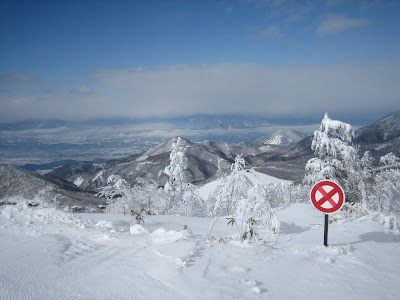
 I began work with the ski patrol the following day. A typical work day consisted of an initial sweep of the mountain to ensure that no dangerous spots were unmarked, and all previously marked areas were still visibly taped off or matted. What a joy to work on skis. Throughout the day we would make a handful of patrols, which were more or less similar in principle to this initial sweep. In the meantime, I would sit in the patrol
 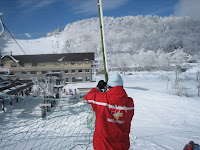 office with whoever wasn't off on a job, answering phones, manning the information/emergency window, or studying the textbook on emergency procedures. Although the majority of the time was sitting in the office, I did get to be on the slope for 3 or 4 hours a day.
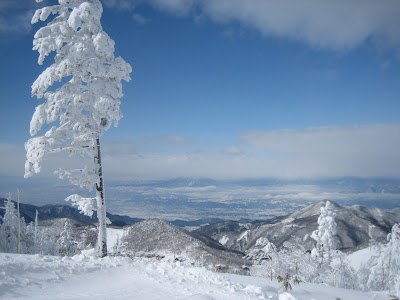
I really didn't see many emergencies during my two weeks there. People would trickle in everyday or so with an injury, and once or twice we had to remove someone from the mountain due to a debilitating injury. But we would just send them to the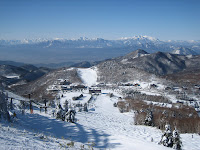 clinic that was down the mountain. And on the occasion that the "real" patrolmen treated an injury, I couldn't really help. The one exception happened about a week into the job. I was hastened from the patrol office down the stairs from the skiers restaurant to find a one-year old baby and her mother with blood gushing from the baby's nose. They had brought me because the family was from Australia and couldn't speak any Japanese. The baby had fallen down the stairs and had hit its face on the step, and because of all the blood the mother was afraid the baby had broken its nose. Through my broken Japanese, I tried to help communicate the other patrolman's commands. I accompanied the baby on snowmobile to the nearby clinic, to find that the nose was ok but it was the 3 cm cut under the nose that was the cause of the blood. After 2 stitches the Australian family called it a day and left for their hotel.
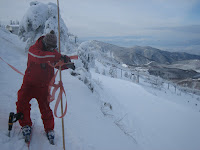 Although the majority of the time was sitting in the office, the other patrolmen and other workers were intensely amusing, friendly, and accomodating. The patrol was split into two main areas, and so I became close with the three others with which I worked everyday. Tamura, the head patrolman, insisted that when called over the walkie-talkie I answer him with "yes sir, boss sir" much to the hilarity of the rest of the walkie-talkie carrying patrol. On my first day, when in the company of another ski patroller named Yusuke , everyone without fail
  would announce that Yusuke was stupid and that I shouldn't listen to his Japanese so as not to pick up any vulgar speech habits. And Ryuji is the most personable, warm, friendly person I've met since coming to Japan. He is the type of person that people respect because of his loving care for fellow human beings. I'll never forget anyone I met during my two weeks there, but especially I won't forget Ryuji for his humanness.
The majority of other people working on the slope were roughly from 21 to 28 years old. All were snowboarders and most were from Nagano prefecture, although there were some from the Nagoya area, Tokyo, Kobe area, and Kyoto, among other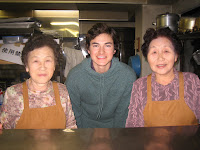 places. And then there was the older women from Aomori Prefecture who worked in the cafeteria. With their stooped walk, wrinkly smiles, and warm yet unintelligable greetings they made the cafeteria shine with tenderness. Although I could never understand what they would say due to the differing dialects/accents, they always gave the impression of surprised pleasure whenever I sat down to eat.
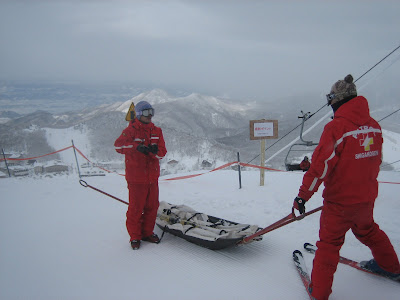
I was lucky enough to take part in a few training scenarios with the other patrolmen.
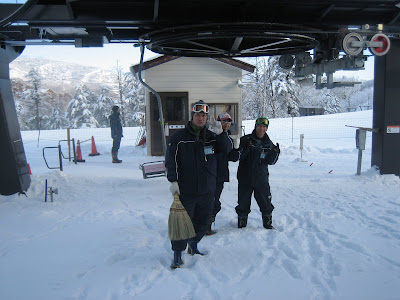
Noguchi-san and me.
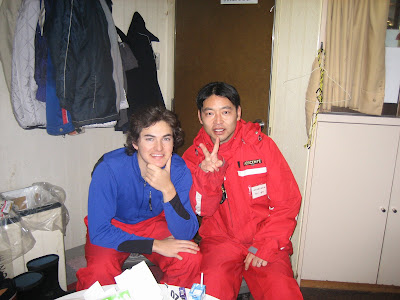
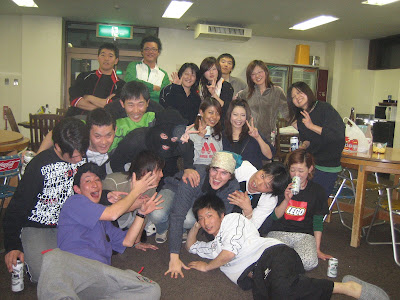
A goodbye party was held on the last night.

 I began work with the ski patrol the following day. A typical work day consisted of an initial sweep of the mountain to ensure that no dangerous spots were unmarked, and all previously marked areas were still visibly taped off or matted. What a joy to work on skis. Throughout the day we would make a handful of patrols, which were more or less similar in principle to this initial sweep. In the meantime, I would sit in the patrol
  office with whoever wasn't off on a job, answering phones, manning the information/emergency window, or studying the textbook on emergency procedures. Although the majority of the time was sitting in the office, I did get to be on the slope for 3 or 4 hours a day.
I really didn't see many emergencies during my two weeks there. People would trickle in everyday or so with an injury, and once or twice we had to remove someone from the mountain due to a debilitating injury. But we would just send them to the
 clinic that was down the mountain. And on the occasion that the "real" patrolmen treated an injury, I couldn't really help. The one exception happened about a week into the job. I was hastened from the patrol office down the stairs from the skiers restaurant to find a one-year old baby and her mother with blood gushing from the baby's nose. They had brought me because the family was from Australia and couldn't speak any Japanese. The baby had fallen down the stairs and had hit its face on the step, and because of all the blood the mother was afraid the baby had broken its nose. Through my broken Japanese, I tried to help communicate the other patrolman's commands. I accompanied the baby on snowmobile to the nearby clinic, to find that the nose was ok but it was the 3 cm cut under the nose that was the cause of the blood. After 2 stitches the Australian family called it a day and left for their hotel.
  Although the majority of the time was sitting in the office, the other patrolmen and other workers were intensely amusing, friendly, and accomodating. The patrol was split into two main areas, and so I became close with the three others with which I worked everyday. Tamura, the head patrolman, insisted that when called over the walkie-talkie I answer him with "yes sir, boss sir" much to the hilarity of the rest of the walkie-talkie carrying patrol. On my first day, when in the company of another ski patroller named Yusuke , everyone without fail
  would announce that Yusuke was stupid and that I shouldn't listen to his Japanese so as not to pick up any vulgar speech habits. And Ryuji is the most personable, warm, friendly person I've met since coming to Japan. He is the type of person that people respect because of his loving care for fellow human beings. I'll never forget anyone I met during my two weeks there, but especially I won't forget Ryuji for his humanness.
 The majority of other people working on the slope were roughly from 21 to 28 years old. All were snowboarders and most were from Nagano prefecture, although there were some from the Nagoya area, Tokyo, Kobe area, and Kyoto, among other
 places. And then there was the older women from Aomori Prefecture who worked in the cafeteria. With their stooped walk, wrinkly smiles, and warm yet unintelligable greetings they made the cafeteria shine with tenderness. Although I could never understand what they would say due to the differing dialects/accents, they always gave the impression of surprised pleasure whenever I sat down to eat.
I was lucky enough to take part in a few training scenarios with the other patrolmen.

Noguchi-san and me.


A goodbye party was held on the last night.


Shigakogen (1 of 2)
I just arrived back in Kyoto after a three week winter break in Shigakogen, which sits in the northeastern corner of Nagano prefecture. I'll try to make the recapitulation short. Before I had any concrete plans for the break, I knew I wanted to spend it skiing somewhere. This, I soon realized, would be an enormously expensive vacation if I simply spent my time skiing, and an enormously lonely vacation if I did it alone. So, I asked around to see if anyone wanted to join me, and thankfully I found that my friend Alan had similar plans. Thus, we began formulating ideas about how to go about skiing in the most cost-effective manner.
It turned out that Alan's ex-hostmother from Tokyo often spends time in Shigakogen, and she kindly offered to write us a recommendation for a position at the Swiss Inn, the hotel that she frequents. It was this connection that got things moving, and ultimately we were offered jobs that included a place to stay, meals, and free ski tickets.
Alan left a few days before I did, as I had a Christmas party to attend. By a 9-hr overnight bus, I arrived at the Swiss Inn of Shigakogen on Christmas Eve morning and had the day to take in the hotel and the immediate surroundings. At first glance, things didn't seem overly unbearable. We were given a relatively large room to stay in, although it was thoroughly soaked in years of cigarette smoke (thank you Febreze), and our employers were very friendly. From his two-day work experience, Alan helped me get accustomed to the environment.
However, over the course of 5 days, the real work environment was revealed to us. I don't want to harp on it too much, but just to give you an idea of what the life was like I'll add some detail. With the exception of Christmas Eve and Christmas day when Christmas music was piped through the entire hotel including our room (which we weren't able to turn down or off), Swiss jodelling music would permeate every nook and cranny of our day. Afterall, it is the Swiss Inn, but you'd be amazed at what one can get used to. The staff would smoke throughout the day, around the prepared food, and even while preparing food. And when you've worked for hours without a break, while the majority of the staff are sitting around smoking and talking, it gets on one's nerves. But it wasn't the discrepancy of work. Perhaps it was the work hours which started at a meager 9.5 hours and by the 4th day had reached 13 hours, and would have most likely increased had we not taken emergency actions.
On my third day there, after the morning's 6 hours of work, Alan and I decided to take advantage of the free ski tickets (which turned out to only be valid for 2 lifts). By this time, I had almost already reached my breaking point from the work, so I had begun to think about alternate options. Ski rescue, avalanche rescue, and the related emergency mountain-related procedures came to mind. Thus, I decided to take this opportunity out of Swiss Inn to visit the Shigakogen ski patrol office to enquire about possible classes. I knocked on the patrol office and was confronted by two patrol officers, and through my broken Japanese, I related my aforementioned interests. They looked startled and confused and pointed me into the administrative office. This time to a higher official, I once again tried to explain my interest in these classes, only to hear that there were no such courses offered in the entire area. I was crestfallen. But, to my surprise, right there and then I was offered a job on the ski patrol, without a single question about my skiing ability. I didn't really know if I should accept it or not since I didn't want to abandon Alan, and at that time I still had a feeling of obligation toward the Swiss Inn. But as things went from bad to horrible at the hotel, I finally decided to take the job. And by that point, the previously hesitant Alan had also been convinced of the impossibility to continue the work at the Swiss Inn. Our last day at the hotel, I brought Alan to see the patrol and they also offered him a job, as a liftman. With everything in place for a clean departure, we packed our bags and walked out the door of the Swiss Inn into the sun-blanketed field of white snow leading to the dorm of our next employer...
(1 of 2)
It turned out that Alan's ex-hostmother from Tokyo often spends time in Shigakogen, and she kindly offered to write us a recommendation for a position at the Swiss Inn, the hotel that she frequents. It was this connection that got things moving, and ultimately we were offered jobs that included a place to stay, meals, and free ski tickets.
Alan left a few days before I did, as I had a Christmas party to attend. By a 9-hr overnight bus, I arrived at the Swiss Inn of Shigakogen on Christmas Eve morning and had the day to take in the hotel and the immediate surroundings. At first glance, things didn't seem overly unbearable. We were given a relatively large room to stay in, although it was thoroughly soaked in years of cigarette smoke (thank you Febreze), and our employers were very friendly. From his two-day work experience, Alan helped me get accustomed to the environment.
However, over the course of 5 days, the real work environment was revealed to us. I don't want to harp on it too much, but just to give you an idea of what the life was like I'll add some detail. With the exception of Christmas Eve and Christmas day when Christmas music was piped through the entire hotel including our room (which we weren't able to turn down or off), Swiss jodelling music would permeate every nook and cranny of our day. Afterall, it is the Swiss Inn, but you'd be amazed at what one can get used to. The staff would smoke throughout the day, around the prepared food, and even while preparing food. And when you've worked for hours without a break, while the majority of the staff are sitting around smoking and talking, it gets on one's nerves. But it wasn't the discrepancy of work. Perhaps it was the work hours which started at a meager 9.5 hours and by the 4th day had reached 13 hours, and would have most likely increased had we not taken emergency actions.
On my third day there, after the morning's 6 hours of work, Alan and I decided to take advantage of the free ski tickets (which turned out to only be valid for 2 lifts). By this time, I had almost already reached my breaking point from the work, so I had begun to think about alternate options. Ski rescue, avalanche rescue, and the related emergency mountain-related procedures came to mind. Thus, I decided to take this opportunity out of Swiss Inn to visit the Shigakogen ski patrol office to enquire about possible classes. I knocked on the patrol office and was confronted by two patrol officers, and through my broken Japanese, I related my aforementioned interests. They looked startled and confused and pointed me into the administrative office. This time to a higher official, I once again tried to explain my interest in these classes, only to hear that there were no such courses offered in the entire area. I was crestfallen. But, to my surprise, right there and then I was offered a job on the ski patrol, without a single question about my skiing ability. I didn't really know if I should accept it or not since I didn't want to abandon Alan, and at that time I still had a feeling of obligation toward the Swiss Inn. But as things went from bad to horrible at the hotel, I finally decided to take the job. And by that point, the previously hesitant Alan had also been convinced of the impossibility to continue the work at the Swiss Inn. Our last day at the hotel, I brought Alan to see the patrol and they also offered him a job, as a liftman. With everything in place for a clean departure, we packed our bags and walked out the door of the Swiss Inn into the sun-blanketed field of white snow leading to the dorm of our next employer...
(1 of 2)
Thursday, November 23, 2006
Momiji Hunting
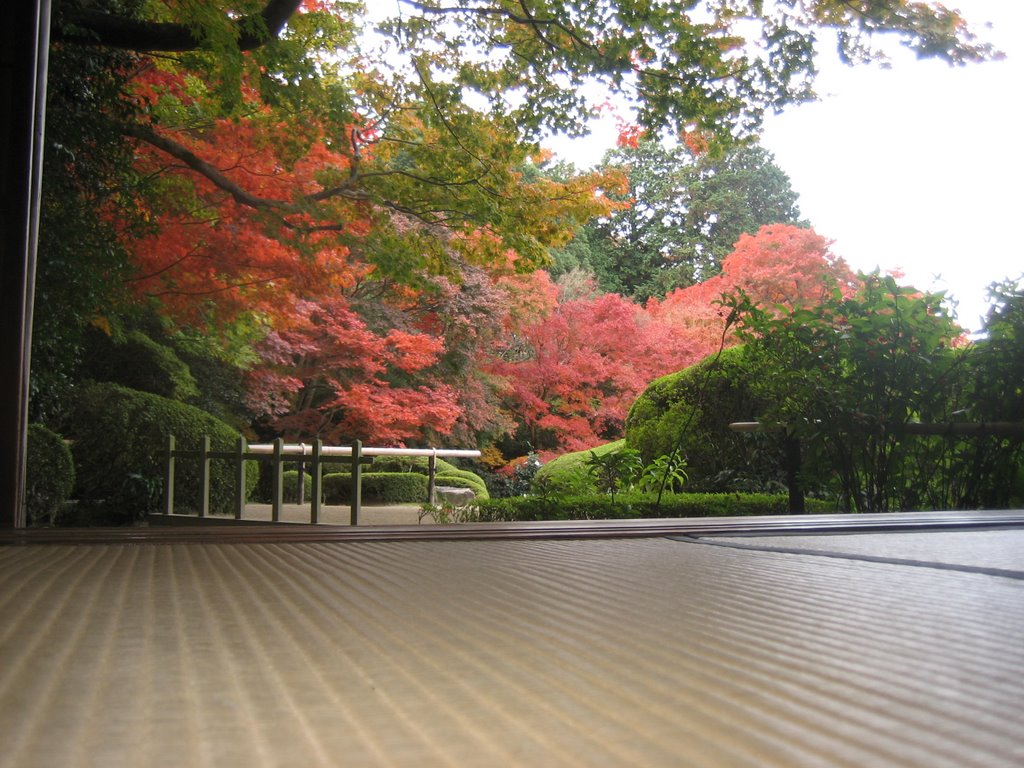
Yesterday was Kinryo-kansha day, which is a sort of Labor Day, and classes were dismissed. I took this opportunity to finally do some much needed capturing of the maple leaves' glorious range of colors that engulf Kyoto in these weeks (perhaps coming to an end next week). Yesterday morning I visited two favorite spots and took a few pictures.
Shinyodo, 15 minutes south of Ginkakuji on foot


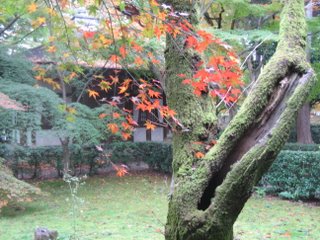


Shisendo, in northern Sakyo-ku, 15 min from my house on bike


Shinyodo, 15 minutes south of Ginkakuji on foot
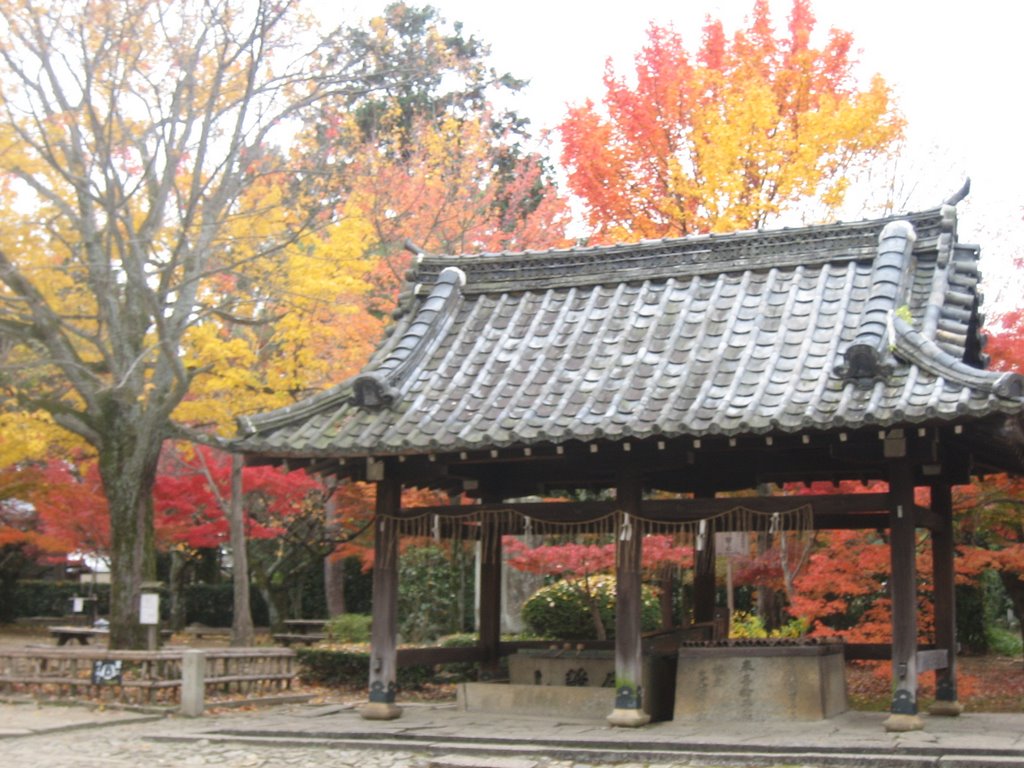
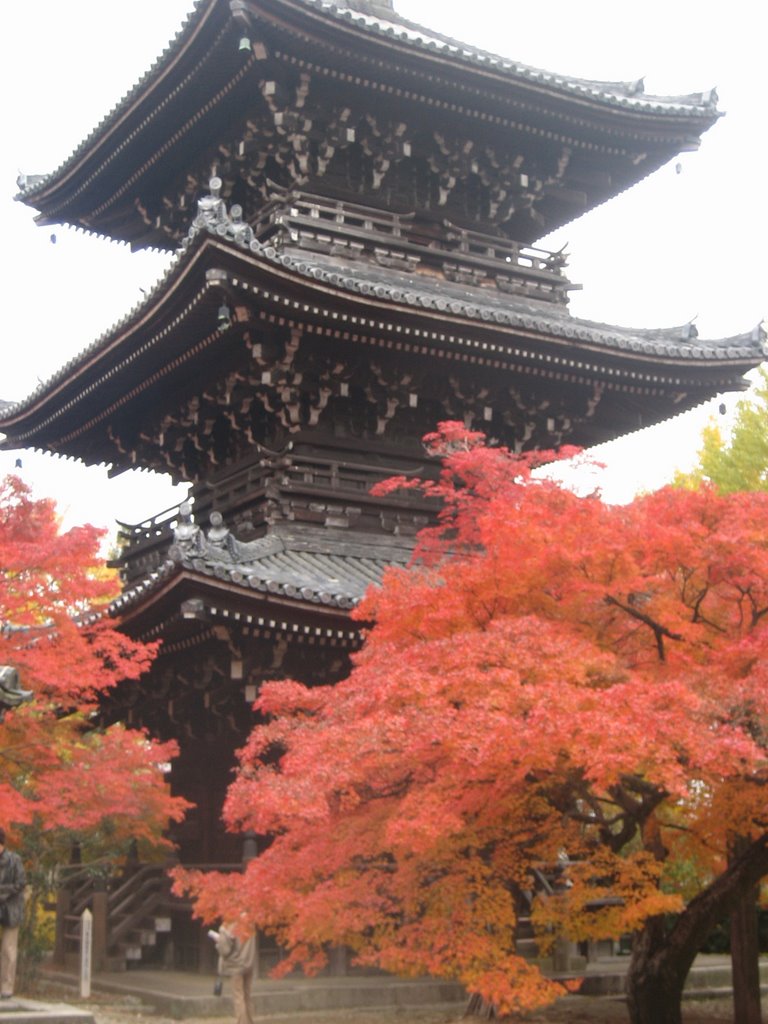


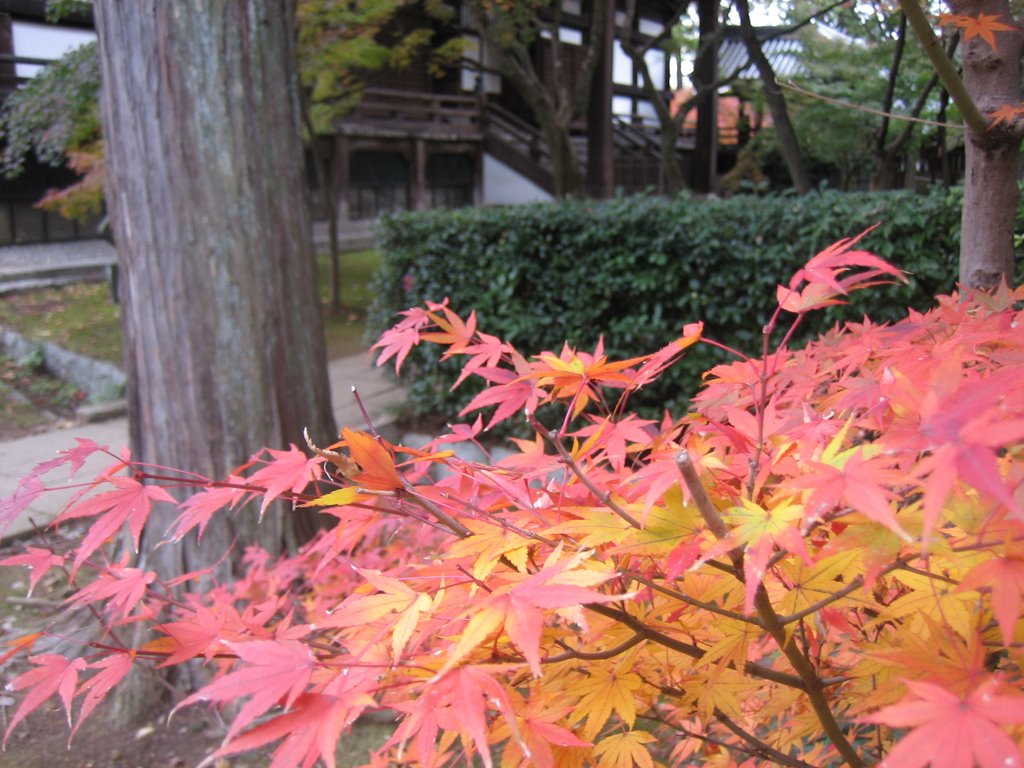


Shisendo, in northern Sakyo-ku, 15 min from my house on bike


Monday, November 20, 2006
Question...
There has been great debate regarding the following poem by Basho Matsuo.
古池や 蛙飛び込む 水の音
The old pond;
a frog jumps in,
the sound of water.
There is no plural in Japanese, so the use of "a" in "a frog" may be misleading.
How many frogs do you think there are? Why do you think so?
I'd like to hear your opinion. So please comment below.
古池や 蛙飛び込む 水の音
The old pond;
a frog jumps in,
the sound of water.
There is no plural in Japanese, so the use of "a" in "a frog" may be misleading.
How many frogs do you think there are? Why do you think so?
I'd like to hear your opinion. So please comment below.
Hikone Castle and the Ii family's garden
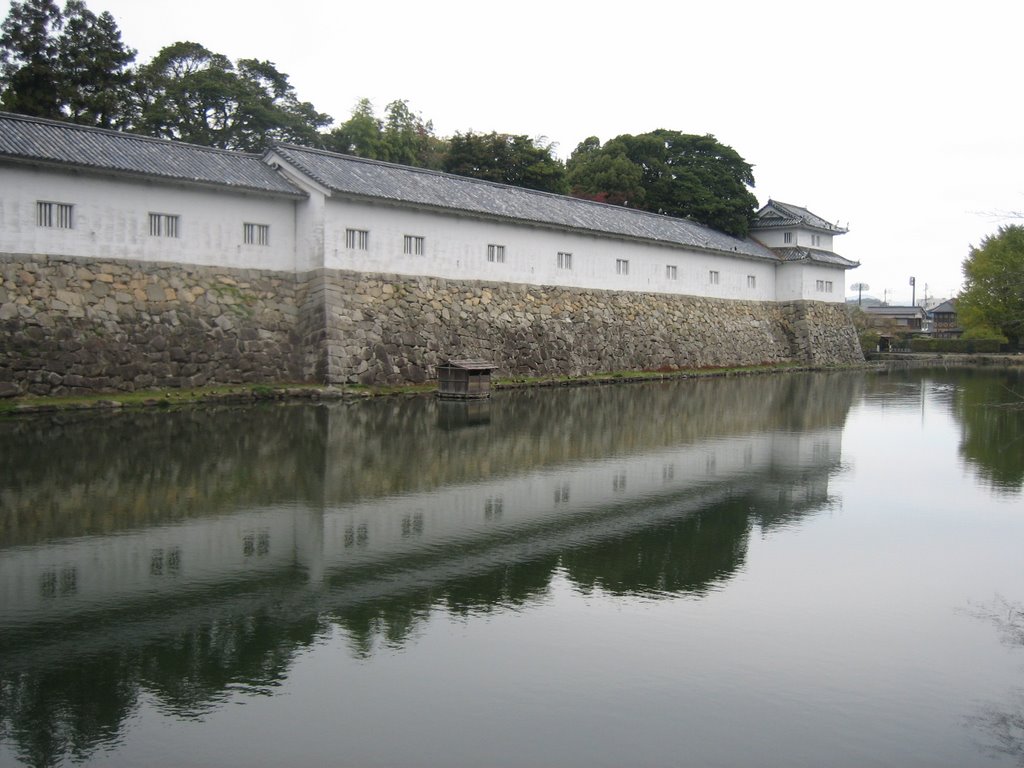
Every couple weeks, the Cities and Civilization class ventures into different parts of Japan to explore areas that were important to or representative of the current era of study. Last weekend, we boarded the train to Hikone the location of the Ii family's castle, one of the oldest surviving castles in Japan.
Our professor (and tour guide) split us into two groups: attackers and defenders. Here he begins the lecture:

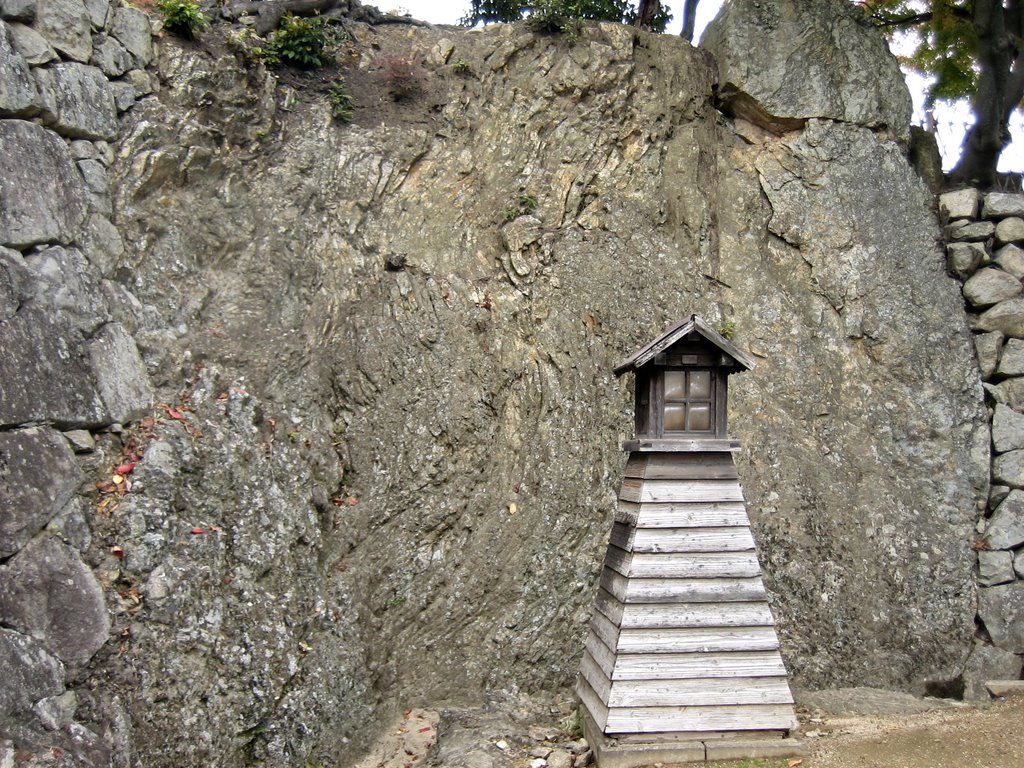
The texture warranted a picture:
The castle:

The view from the castle:
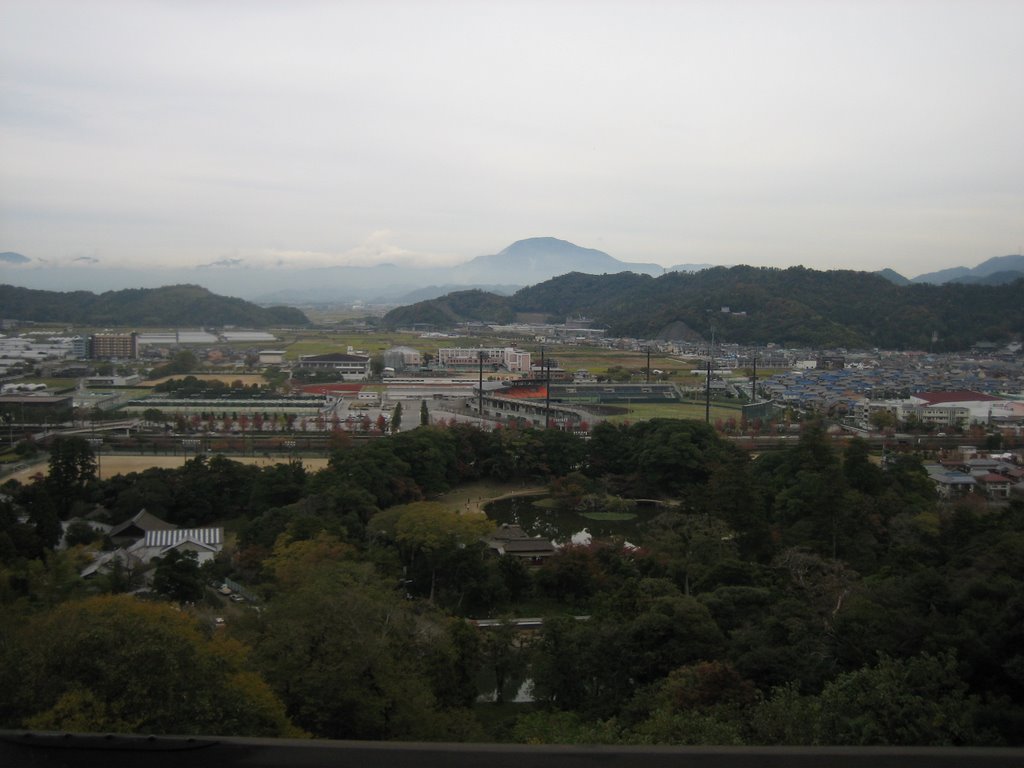
After being thoroughly routed by the attackers at the castle, we strolled down to the Genkyo-en garden, which was designed in the Chisen-kaiyu style, being centered around a pond, just beyond the inner moat.


Fall colors dotted the pathway around the pond:
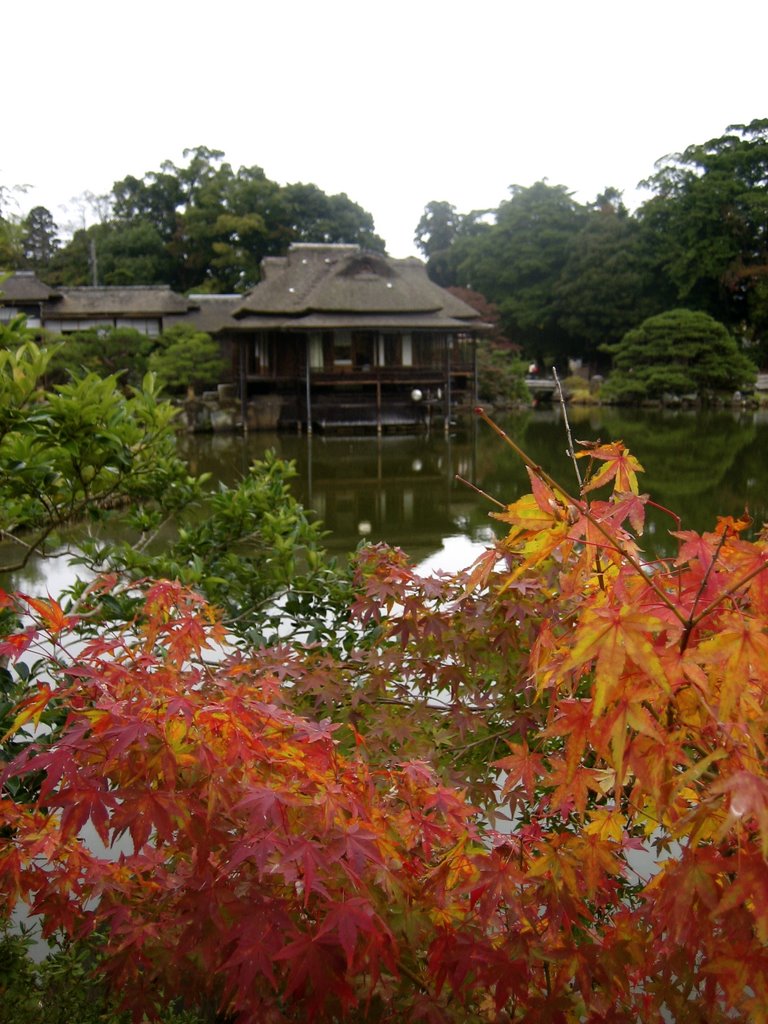

Walking through the garden:

In the "rakuraku" viewing house on the pond:
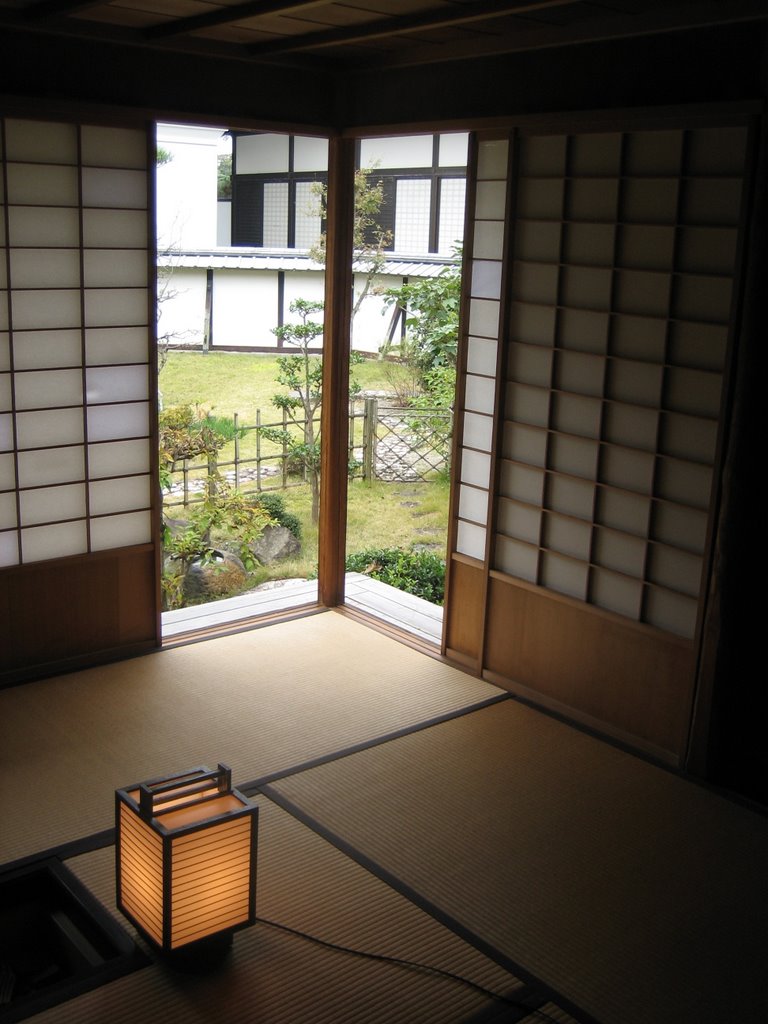
The water stopped in time:

Subscribe to:
Posts (Atom)